
How America
Powers the
AI Revolution
The only podcast connecting energy infrastructure, AI compute, utilities, nuclear, and construction — with the people actually building America's power future.
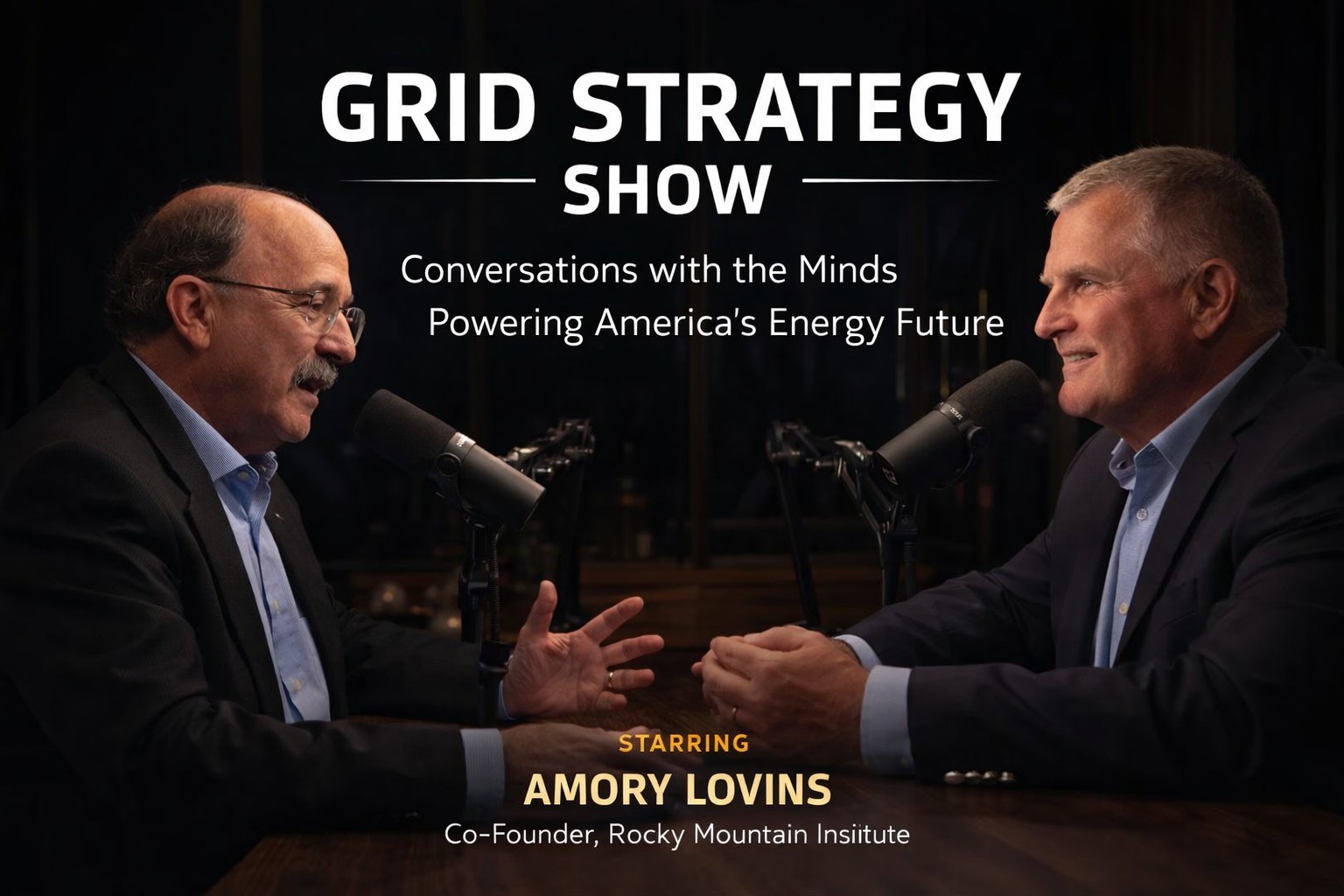
Efficiency First
Amory Lovins — Co-Founder, Rocky Mountain Institute
One of the world's foremost energy thinkers joins us to discuss the critical challenges facing the US National Electrical Grid — from surging AI data center demand and mass EV adoption, to the policy and infrastructure reforms needed to modernize transmission and unlock a resilient, efficient, clean energy future.
Topics Covered
- Grid modernization under increased load
- Efficiency as the first fuel
- Transmission infrastructure bottlenecks
- Distributed energy resources
Upcoming Episodes
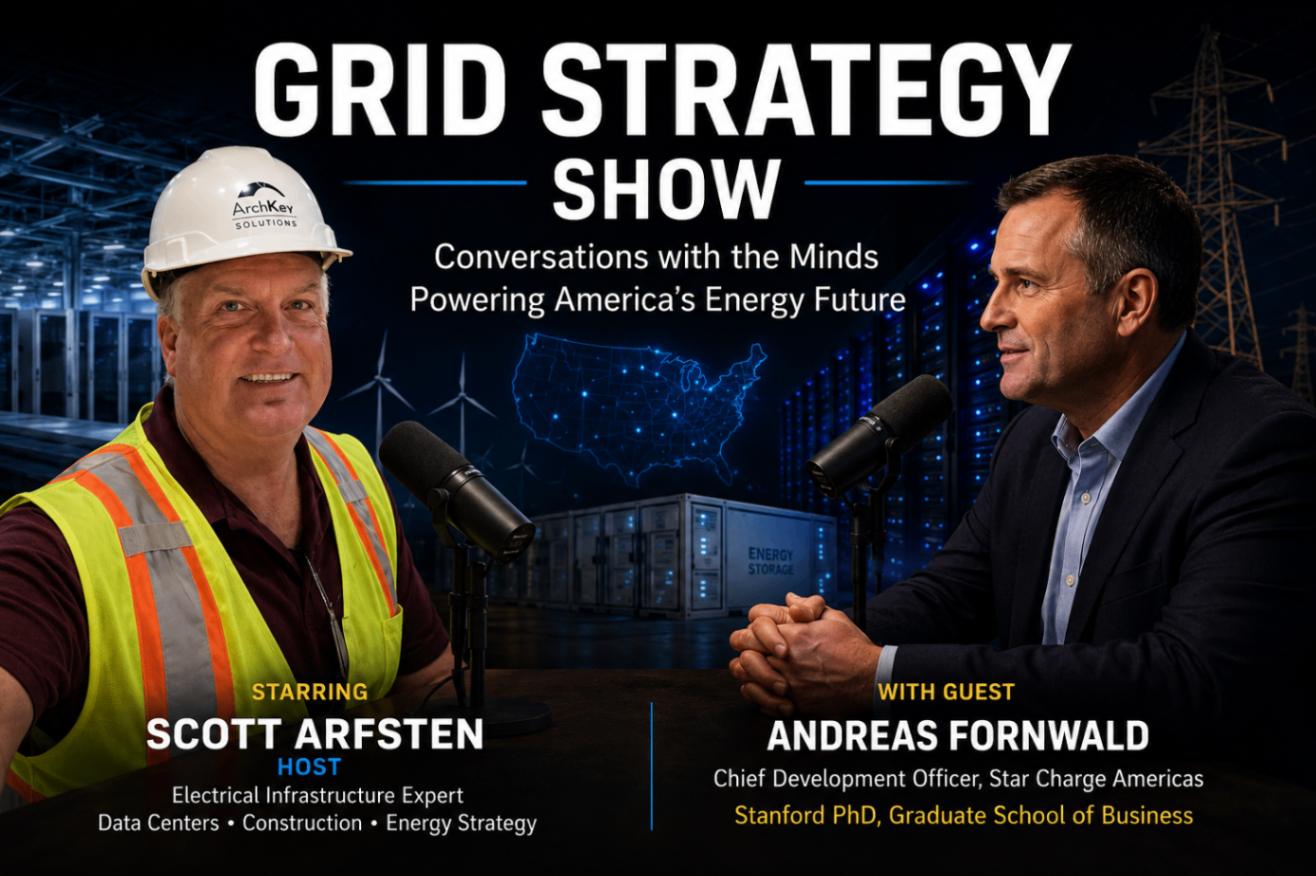
Battery Storage & the AI Grid
Andreas Fornwald — Chief Development Officer, Star Charge Americas | Stanford PhD, Graduate School of Business
As AI factories and data centers drive unprecedented electricity demand, Andreas Fornwald — CDO of Star Charge Americas and former CEO of Doosan GridTech — joins us to discuss battery energy storage, microgrids, and the infrastructure strategies powering the next era of the grid.
Powering AI Factories: Bill Gates' Plan to Reinvent Nuclear Energy
Chris Levesque — TerraPower — President & CEO, TerraPower | Bill Gates' Advanced Nuclear Venture
Scott Arfsten interviews Chris Levesque, President & CEO of TerraPower — Bill Gates' advanced nuclear venture. Levesque accepted the award recognizing TerraPower's role in powering the AI economy with always-on, zero-carbon baseload.
TerraPower was founded by Bill Gates with a single conviction: that advanced nuclear is the only technology capable of delivering the always-on, carbon-free baseload power the AI economy demands at the scale and speed the grid requires. Chris Levesque — President & CEO — joins Scott Arfsten to discuss the Natrium reactor, the Kemmerer, Wyoming deployment, and why Gates accepted the award for this work as a defining bet on America's energy future. From NRC licensing to the economics of nuclear-plus-storage, this is the conversation about what it actually takes to reinvent nuclear power in the 21st century.
Insuring the Impossible: The Risk Architecture Behind America's First Advanced Nuclear Project
Neil Duren — Managing Director, Renewable Power & Clean Energy | Nuclear Growth Leader | 2026 Power Broker Finalist
Before a single watt flows from TerraPower's Natrium reactor in Kemmerer, Wyoming, someone has to underwrite it. Neil Duren — Managing Director for Renewable Power & Clean Energy and one of the country's foremost nuclear insurance specialists — joins Scott Arfsten to pull back the curtain on what it actually takes to insure the first advanced nuclear project of its kind. From SMR and fusion risk frameworks to the 2024 Risk Team of the Year recognition, Duren sits at the intersection of capital, risk, and the clean energy transition. If nuclear is going to power the AI economy, the insurance architecture has to be built first.
Future Grid
Stanford Precourt Institute for Energy — Stanford University
Leading researchers from Stanford's Precourt Institute for Energy join us to discuss the science, policy, and economics behind the next-generation US grid — from advanced storage and transmission to the academic frameworks shaping how utilities and regulators plan for a clean energy future.

The Legal Architecture of the Modern Grid: How Utility Law Shapes America's Energy Future
Grady Mathai-Jackson — General Counsel, Pacific Gas & Electric (PG&E) | Energy Law & Policy Expert
The grid doesn't just run on electrons — it runs on law, regulation, and policy. Grady Mathai-Jackson, General Counsel of Pacific Gas & Electric, joins Scott Arfsten to discuss the legal and regulatory architecture that governs how America's largest utilities operate, invest, and adapt. From FERC interconnection queues to wildfire liability, rate design to clean energy mandates, Mathai-Jackson offers a rare inside view of how utility law shapes — and sometimes constrains — the pace of the energy transition. As AI data centers drive unprecedented new load onto the California grid, the legal frameworks that govern PG&E's response have never mattered more.
AI Factory Energy Demand
NVIDIA — AI Infrastructure & Energy
NVIDIA's AI factories are among the most power-intensive facilities ever built. We explore the energy demands of next-generation AI compute infrastructure — and what it means for grid planning, utility partnerships, and the race to build sufficient power capacity.
Small Modular Reactors & the Microreactor Revolution
Oklo — Advanced Nuclear — Microreactor Technology
Oklo is building compact, fast fission microreactors designed to power remote sites, data centers, and industrial facilities that can't wait years for grid interconnection. We explore how microreactor technology complements TerraPower's utility-scale Natrium reactor — and why the nuclear renaissance is happening at every scale simultaneously.
Baseload Power: Geothermal
Geothermal Energy Leader — Next-Generation Geothermal
Enhanced geothermal systems are unlocking clean, firm baseload power anywhere on earth. We explore how next-generation geothermal technology could become a cornerstone of the 24/7 clean grid — providing the dispatchable power that wind and solar alone cannot.
Real-World Power Challenges
Data Center Operator — Hyperscale Data Center Operations
The people actually building and running hyperscale data centers share the ground-level reality of securing power — from utility negotiations and interconnection queues to on-site generation and the infrastructure decisions that determine where AI compute gets built.

The Hyperscale Hero: Power Constraints & the AI Infrastructure Race
Guy Massey — Global Service Delivery Lead, CommScope | Strategic Advisor — Data Centres & Hyperscalers
Guy Massey spent 40 years in tech — the last 20 deep inside hyperscale data center operations at Google, Microsoft, Meta, AWS, and NVIDIA. He built Google's ITAD decommissioning division from scratch, saving $1.5B+ over a decade and moving 2.5 million pieces of equipment. Now at CommScope leading global service delivery for the world's largest hyperscalers, he joins the show to talk about the real finish-line problem: power constraints, permit battles, water scarcity, and the infrastructure decisions that will shape America's energy grid for the next decade.
Fuel Cells & the On-Site Power Imperative
KR Sridhar — Bloom Energy — Founder & CEO, Bloom Energy
KR Sridhar co-founded Bloom Energy in 2001 after working with NASA on technology to support life on Mars. Today, Bloom's solid oxide fuel cells are solving AI's most urgent problem: getting gigawatts of reliable, clean power to data centers in months — not the years it takes to queue for grid interconnection. With a $28B market cap, a $5B Brookfield partnership, and deals with Oracle, AEP, and Equinix, Bloom is no longer a clean energy bet — it's critical infrastructure for the AI economy.
AI-Powered Grid Health: The $64M Bet on Predictive Infrastructure
GridCare — GridCare — Grid Intelligence & Predictive Maintenance
GridCare has raised $64 million to bring AI-powered predictive maintenance and real-time health monitoring to the US electrical grid. As aging infrastructure faces unprecedented load growth from data centers and electrification, GridCare's platform identifies failure risks before they cascade — reducing outages, extending asset life, and giving utilities the intelligence they need to manage a grid under stress. This is the software layer the physical grid has been missing.
Carbon Storage & the Path to Net Zero
Prof. Sally Benson — Stanford — Precourt Family Professor, Stanford University | Former White House OSTP Energy Division Director
Sally Benson is one of the world's foremost authorities on carbon capture and storage and energy systems analysis. She served as Energy Division Director and Chief Strategist for the Energy Transition at the White House Office of Science and Technology Policy (2021–2023), and has spent two decades at Stanford studying how to decarbonize the grid while keeping the lights on. She joins us to discuss what a credible path to net-zero electricity actually looks like — and what the grid needs to get there.
The Dean of Sustainability on America's Energy Future
Dean Arun Majumdar — Stanford — Inaugural Dean, Stanford Doerr School of Sustainability | Jay Precourt Provostial Chair Professor
Arun Majumdar is the inaugural Dean of the Stanford Doerr School of Sustainability — the first new school at Stanford in 70 years. A mechanical engineer and energy scientist, he previously served as the founding Director of ARPA-E and as Under Secretary of Energy at the US Department of Energy. He brings a rare combination of deep technical expertise, federal policy experience, and institutional leadership to the question of how America transitions its energy system at the speed and scale the climate and the economy demand.
Climate Risk, Grid Resilience & the Wildfire-Power Nexus
Prof. Chris Field — Stanford — Perry L. McCarty Director, Stanford Woods Institute for the Environment | IPCC Working Group II Co-Chair
Chris Field co-chaired Working Group II of the Intergovernmental Panel on Climate Change — the group responsible for assessing climate impacts, adaptation, and vulnerability. His research focuses on the solutions that improve lives now, decrease future warming, and support vibrant economies, with recent work on coastal flooding and wildfire risk. For the US grid, his work is directly relevant: the same climate forces driving extreme weather are the ones stress-testing transmission infrastructure, forcing utilities to rethink resilience from the ground up.
Houston's Geothermal Moment: How a Stanford Spinout Is Rewriting the Energy Transition
Fervo Energy — Fervo Energy — Next-Generation Geothermal Power
Fervo Energy is a Stanford spinout that uses horizontal drilling and fiber-optic sensing technology — borrowed directly from the oil and gas industry — to produce zero-carbon geothermal power at commercial scale. Its recent IPO is more than a capital markets milestone: it's a signal that Houston's deep engineering talent, supply chains, and industrial expertise can be redirected toward the clean energy future. With over 100,000 oil and gas jobs shed in Houston over the past decade, Fervo represents the path forward — one that leans into what Houston already does better than anywhere else.
Know an Expert
We Should Feature?
We're actively booking guests for upcoming episodes. If you're an engineer, economist, regulator, or innovator working on the future of the US grid — we want to hear from you.
Or reach us via the contact form.